Review


mammalian expression vector pcdna3 1  (Addgene inc)


Bioz Verified Symbol Addgene inc is a verified supplier  
  • Logo
  • About
  • News
  • Press Release
  • Team
  • Advisors
  • Partners
  • Contact
  • Bioz Stars
  • Bioz vStars
  • 93

    Structured Review

    Addgene inc mammalian expression vector pcdna3 1
    Mammalian Expression Vector Pcdna3 1, supplied by Addgene inc, used in various techniques. Bioz Stars score: 93/100, based on 1 PubMed citations. ZERO BIAS - scores, article reviews, protocol conditions and more
    https://www.bioz.com/product/mammalian+expression+vector+pcdna3+1/GtCCR2_EYFP_pcDNA3%2E1+(Plasmid+%23159121)/pm40721511-242-22-30
    Average 93 stars, based on 1 article reviews
    mammalian expression vector pcdna3 1 - by Bioz Stars, 2026-11
    93/100 stars

    Images

    Related Articles

    Expressing:

    Article Title: The Involvement of Splicing Factor hnRNP A1 in UVB-Induced Alternative Splicing of hdm2
    Article Snippet: CM-H 2 DCFDA was added into cells 1 h prior to UVB exposure and the reading of fluorescence dye was recorded at 6 h post UVB irradiation using luminometer (Molecular devices Spectra Max M2). .. Mammalian expression vector pcDNA3.1(+) (Addgene) was used to express hnRNP A1, SRSF1, Hdm2-FL and Hdm2B. ..

    Article Title: Lycorine ameliorates bleomycin-induced pulmonary fibrosis via inhibiting NLRP3 inflammasome activation and pyroptosis.
    Article Snippet: Idiopathic pulmonary fibrosis (IPF) is a chronic and irreversible lung disease with limited therapeutic strategies.. Lycorine (LYC), an alkaloid isolated from Amaryllidaceae family plants, exhibits effective anti-inflammatory, antiviral, and anti-tumor activities.. In this study, we attempted to determine the effect of LYC on bleomycin (BLM)-induced IPF and NLRP3 inflammasome activation.

    Article Title: Efficient and sustained optogenetic control of sensory and cardiac systems.
    Article Snippet: The humanized DNA sequence, coding for CoChR (Chloromonas oogama ChR, accession number KF992041 (refs. 48,50), Addgene plasmid 59070), C-terminally fused to eGFP and the humanized DNA sequence, coding for GtCCR4 (Guillardia theta ChR 4, accession number MF039475.1 (refs. 50,51)), C-terminally fused to eYFP, were cloned into the mammalian expression vector pcDNA3.1 (−) (Invitrogen). .. The humanized DNA sequence, coding for GtCCR2 (G. theta ChR2, accession number XM_005841372 (ref. 51) C-terminally fused to eYFP, cloned into the mammalian expression vector pcDNA3.1 (−), were obtained from Addgene (plasmid 159121). ..

    Article Title: Sphaeropsidin A covalently binds to Cys 151 of Keap1 to attenuate LPS-induced acute pneumonia in mice.
    Article Snippet: Introduction: Kelch ECH-associating protein 1 (Keap1)-Nuclear factor erythroid 2-related factor 2 (Nrf2) axis is crucial for regulating oxidative stress and inflammatory responses in acute pneumonia.. Sphaeropsidin A (SA) is a antioxidant diterpenoid isolated from Sphaeropsis sapinea f. sp. cupressi, discovered as a novel Nrf2 agonist by our research group previously.. However, the accurate function and mechanism of SA in treating acute pneumonia are

    Article Title: Tumor suppressor RBM24 inhibits nuclear translocation of CTNNB1 and TP63 expression in liver cancer cells
    Article Snippet: We constructed an RBM24 overexpressing DNA plasmid (6.7 kb) using pcDNA3.1 (Addgene, Inc.). .. The cDNA of RBM24 (720 bp fragment of RBM24 transcript variant 1 mRNA, GenBank accession no. NM_001143942.1) was ligated to the mammalian expression vector pcDNA3.1 (Addgene, Inc.), amplified in Escherichia coli (E. coli) DH5a, identified by restriction analysis ( Bam HI and Eco RI), and sequenced. ..

    Article Title: Sphaeropsidin A covalently binds to Cys 151 of Keap1 to attenuate LPS-induced acute pneumonia in mice
    Article Snippet: .. The cDNAs for NLRP3 and ASC were obtained using standard PCR techniques from HeLa cells and subsequently inserted into the mammalian expression vector pcDNA3.1(+) (Addgene, Watertown, MA, USA), to introduce the FLAG-tag and Myc-tag respectively. ..

    Polymerase Chain Reaction:

    Article Title: Lycorine ameliorates bleomycin-induced pulmonary fibrosis via inhibiting NLRP3 inflammasome activation and pyroptosis.
    Article Snippet: Idiopathic pulmonary fibrosis (IPF) is a chronic and irreversible lung disease with limited therapeutic strategies.. Lycorine (LYC), an alkaloid isolated from Amaryllidaceae family plants, exhibits effective anti-inflammatory, antiviral, and anti-tumor activities.. In this study, we attempted to determine the effect of LYC on bleomycin (BLM)-induced IPF and NLRP3 inflammasome activation.

    Article Title: Sphaeropsidin A covalently binds to Cys 151 of Keap1 to attenuate LPS-induced acute pneumonia in mice.
    Article Snippet: Introduction: Kelch ECH-associating protein 1 (Keap1)-Nuclear factor erythroid 2-related factor 2 (Nrf2) axis is crucial for regulating oxidative stress and inflammatory responses in acute pneumonia.. Sphaeropsidin A (SA) is a antioxidant diterpenoid isolated from Sphaeropsis sapinea f. sp. cupressi, discovered as a novel Nrf2 agonist by our research group previously.. However, the accurate function and mechanism of SA in treating acute pneumonia are

    Article Title: Sphaeropsidin A covalently binds to Cys 151 of Keap1 to attenuate LPS-induced acute pneumonia in mice
    Article Snippet: .. The cDNAs for NLRP3 and ASC were obtained using standard PCR techniques from HeLa cells and subsequently inserted into the mammalian expression vector pcDNA3.1(+) (Addgene, Watertown, MA, USA), to introduce the FLAG-tag and Myc-tag respectively. ..

    Plasmid Preparation:

    Article Title: Lycorine ameliorates bleomycin-induced pulmonary fibrosis via inhibiting NLRP3 inflammasome activation and pyroptosis.
    Article Snippet: Idiopathic pulmonary fibrosis (IPF) is a chronic and irreversible lung disease with limited therapeutic strategies.. Lycorine (LYC), an alkaloid isolated from Amaryllidaceae family plants, exhibits effective anti-inflammatory, antiviral, and anti-tumor activities.. In this study, we attempted to determine the effect of LYC on bleomycin (BLM)-induced IPF and NLRP3 inflammasome activation.

    Article Title: Efficient and sustained optogenetic control of sensory and cardiac systems.
    Article Snippet: The humanized DNA sequence, coding for CoChR (Chloromonas oogama ChR, accession number KF992041 (refs. 48,50), Addgene plasmid 59070), C-terminally fused to eGFP and the humanized DNA sequence, coding for GtCCR4 (Guillardia theta ChR 4, accession number MF039475.1 (refs. 50,51)), C-terminally fused to eYFP, were cloned into the mammalian expression vector pcDNA3.1 (−) (Invitrogen). .. The humanized DNA sequence, coding for GtCCR2 (G. theta ChR2, accession number XM_005841372 (ref. 51) C-terminally fused to eYFP, cloned into the mammalian expression vector pcDNA3.1 (−), were obtained from Addgene (plasmid 159121). ..

    Article Title: Tumor suppressor RBM24 inhibits nuclear translocation of CTNNB1 and TP63 expression in liver cancer cells
    Article Snippet: We constructed an RBM24 overexpressing DNA plasmid (6.7 kb) using pcDNA3.1 (Addgene, Inc.). .. The cDNA of RBM24 (720 bp fragment of RBM24 transcript variant 1 mRNA, GenBank accession no. NM_001143942.1) was ligated to the mammalian expression vector pcDNA3.1 (Addgene, Inc.), amplified in Escherichia coli (E. coli) DH5a, identified by restriction analysis ( Bam HI and Eco RI), and sequenced. ..

    Introduce:

    Article Title: Lycorine ameliorates bleomycin-induced pulmonary fibrosis via inhibiting NLRP3 inflammasome activation and pyroptosis.
    Article Snippet: Idiopathic pulmonary fibrosis (IPF) is a chronic and irreversible lung disease with limited therapeutic strategies.. Lycorine (LYC), an alkaloid isolated from Amaryllidaceae family plants, exhibits effective anti-inflammatory, antiviral, and anti-tumor activities.. In this study, we attempted to determine the effect of LYC on bleomycin (BLM)-induced IPF and NLRP3 inflammasome activation.

    Article Title: Sphaeropsidin A covalently binds to Cys 151 of Keap1 to attenuate LPS-induced acute pneumonia in mice.
    Article Snippet: Introduction: Kelch ECH-associating protein 1 (Keap1)-Nuclear factor erythroid 2-related factor 2 (Nrf2) axis is crucial for regulating oxidative stress and inflammatory responses in acute pneumonia.. Sphaeropsidin A (SA) is a antioxidant diterpenoid isolated from Sphaeropsis sapinea f. sp. cupressi, discovered as a novel Nrf2 agonist by our research group previously.. However, the accurate function and mechanism of SA in treating acute pneumonia are

    Article Title: Sphaeropsidin A covalently binds to Cys 151 of Keap1 to attenuate LPS-induced acute pneumonia in mice
    Article Snippet: .. The cDNAs for NLRP3 and ASC were obtained using standard PCR techniques from HeLa cells and subsequently inserted into the mammalian expression vector pcDNA3.1(+) (Addgene, Watertown, MA, USA), to introduce the FLAG-tag and Myc-tag respectively. ..

    Hemagglutination Assay:

    Article Title: Lycorine ameliorates bleomycin-induced pulmonary fibrosis via inhibiting NLRP3 inflammasome activation and pyroptosis.
    Article Snippet: Idiopathic pulmonary fibrosis (IPF) is a chronic and irreversible lung disease with limited therapeutic strategies.. Lycorine (LYC), an alkaloid isolated from Amaryllidaceae family plants, exhibits effective anti-inflammatory, antiviral, and anti-tumor activities.. In this study, we attempted to determine the effect of LYC on bleomycin (BLM)-induced IPF and NLRP3 inflammasome activation.

    Sequencing:

    Article Title: Efficient and sustained optogenetic control of sensory and cardiac systems.
    Article Snippet: The humanized DNA sequence, coding for CoChR (Chloromonas oogama ChR, accession number KF992041 (refs. 48,50), Addgene plasmid 59070), C-terminally fused to eGFP and the humanized DNA sequence, coding for GtCCR4 (Guillardia theta ChR 4, accession number MF039475.1 (refs. 50,51)), C-terminally fused to eYFP, were cloned into the mammalian expression vector pcDNA3.1 (−) (Invitrogen). .. The humanized DNA sequence, coding for GtCCR2 (G. theta ChR2, accession number XM_005841372 (ref. 51) C-terminally fused to eYFP, cloned into the mammalian expression vector pcDNA3.1 (−), were obtained from Addgene (plasmid 159121). ..

    Clone Assay:

    Article Title: Efficient and sustained optogenetic control of sensory and cardiac systems.
    Article Snippet: The humanized DNA sequence, coding for CoChR (Chloromonas oogama ChR, accession number KF992041 (refs. 48,50), Addgene plasmid 59070), C-terminally fused to eGFP and the humanized DNA sequence, coding for GtCCR4 (Guillardia theta ChR 4, accession number MF039475.1 (refs. 50,51)), C-terminally fused to eYFP, were cloned into the mammalian expression vector pcDNA3.1 (−) (Invitrogen). .. The humanized DNA sequence, coding for GtCCR2 (G. theta ChR2, accession number XM_005841372 (ref. 51) C-terminally fused to eYFP, cloned into the mammalian expression vector pcDNA3.1 (−), were obtained from Addgene (plasmid 159121). ..

    FLAG-tag:

    Article Title: Sphaeropsidin A covalently binds to Cys 151 of Keap1 to attenuate LPS-induced acute pneumonia in mice.
    Article Snippet: Introduction: Kelch ECH-associating protein 1 (Keap1)-Nuclear factor erythroid 2-related factor 2 (Nrf2) axis is crucial for regulating oxidative stress and inflammatory responses in acute pneumonia.. Sphaeropsidin A (SA) is a antioxidant diterpenoid isolated from Sphaeropsis sapinea f. sp. cupressi, discovered as a novel Nrf2 agonist by our research group previously.. However, the accurate function and mechanism of SA in treating acute pneumonia are

    Article Title: Sphaeropsidin A covalently binds to Cys 151 of Keap1 to attenuate LPS-induced acute pneumonia in mice
    Article Snippet: .. The cDNAs for NLRP3 and ASC were obtained using standard PCR techniques from HeLa cells and subsequently inserted into the mammalian expression vector pcDNA3.1(+) (Addgene, Watertown, MA, USA), to introduce the FLAG-tag and Myc-tag respectively. ..

    Variant Assay:

    Article Title: Tumor suppressor RBM24 inhibits nuclear translocation of CTNNB1 and TP63 expression in liver cancer cells
    Article Snippet: We constructed an RBM24 overexpressing DNA plasmid (6.7 kb) using pcDNA3.1 (Addgene, Inc.). .. The cDNA of RBM24 (720 bp fragment of RBM24 transcript variant 1 mRNA, GenBank accession no. NM_001143942.1) was ligated to the mammalian expression vector pcDNA3.1 (Addgene, Inc.), amplified in Escherichia coli (E. coli) DH5a, identified by restriction analysis ( Bam HI and Eco RI), and sequenced. ..

    Amplification:

    Article Title: Tumor suppressor RBM24 inhibits nuclear translocation of CTNNB1 and TP63 expression in liver cancer cells
    Article Snippet: We constructed an RBM24 overexpressing DNA plasmid (6.7 kb) using pcDNA3.1 (Addgene, Inc.). .. The cDNA of RBM24 (720 bp fragment of RBM24 transcript variant 1 mRNA, GenBank accession no. NM_001143942.1) was ligated to the mammalian expression vector pcDNA3.1 (Addgene, Inc.), amplified in Escherichia coli (E. coli) DH5a, identified by restriction analysis ( Bam HI and Eco RI), and sequenced. ..

    Analysis:

    Article Title: Tumor suppressor RBM24 inhibits nuclear translocation of CTNNB1 and TP63 expression in liver cancer cells
    Article Snippet: We constructed an RBM24 overexpressing DNA plasmid (6.7 kb) using pcDNA3.1 (Addgene, Inc.). .. The cDNA of RBM24 (720 bp fragment of RBM24 transcript variant 1 mRNA, GenBank accession no. NM_001143942.1) was ligated to the mammalian expression vector pcDNA3.1 (Addgene, Inc.), amplified in Escherichia coli (E. coli) DH5a, identified by restriction analysis ( Bam HI and Eco RI), and sequenced. ..


    Similar Products

    99
    Thermo Fisher pcdna3 1 zeocin mammalian expression vector
    Pcdna3 1 Zeocin Mammalian Expression Vector, supplied by Thermo Fisher, used in various techniques. Bioz Stars score: 99/100, based on 1 PubMed citations. ZERO BIAS - scores, article reviews, protocol conditions and more
    https://www.bioz.com/product/mammalian+expression+vector+pcdna3+1/Zeocin/pm24944734__ml4004759_si_001-158-11-15
    Average 99 stars, based on 1 article reviews
    pcdna3 1 zeocin mammalian expression vector - by Bioz Stars, 2026-11
    99/100 stars
      Buy from Supplier

    99
    Thermo Fisher pcdna3 1 amp mammalian expression vector
    Pcdna3 1 Amp Mammalian Expression Vector, supplied by Thermo Fisher, used in various techniques. Bioz Stars score: 99/100, based on 1 PubMed citations. ZERO BIAS - scores, article reviews, protocol conditions and more
    https://www.bioz.com/product/mammalian+expression+vector+pcdna3+1/Ampicillin+trihydrate/pm41015326-99-5-10
    Average 99 stars, based on 1 article reviews
    pcdna3 1 amp mammalian expression vector - by Bioz Stars, 2026-11
    99/100 stars
      Buy from Supplier

    93
    Addgene inc mammalian expression vector pcdna3 1
    Mammalian Expression Vector Pcdna3 1, supplied by Addgene inc, used in various techniques. Bioz Stars score: 93/100, based on 1 PubMed citations. ZERO BIAS - scores, article reviews, protocol conditions and more
    https://www.bioz.com/product/mammalian+expression+vector+pcdna3+1/GtCCR2_EYFP_pcDNA3%2E1+(Plasmid+%23159121)/pm40721511-242-22-30
    Average 93 stars, based on 1 article reviews
    mammalian expression vector pcdna3 1 - by Bioz Stars, 2026-11
    93/100 stars
      Buy from Supplier

    93
    Addgene inc mammalian expression vector pires cyofp1
    Averaged whole cell current traces from cells expressing KCNE1 variants in the homozygous state. Each trace represents JNJ-303 sensitive currents from an average of 21-126 cells co-expressing <t>KCNQ1</t> with the indicated KCNE1 variant. Currents were normalized to peak current in cells expressing WT KCNE1 and WT KCNQ1 recorded in parallel. Scale bars represent 25% of WT (vertical) and 500 ms (horizontal). Location of variants is indicated by the colored labels (green = N-terminus; orange = TM domain; blue = C-terminus).
    Mammalian Expression Vector Pires Cyofp1, supplied by Addgene inc, used in various techniques. Bioz Stars score: 93/100, based on 1 PubMed citations. ZERO BIAS - scores, article reviews, protocol conditions and more
    https://www.bioz.com/product/mammalian+expression+vector+pcdna3+1/NHR1%2B2-Flag+pcDNA3%2E1+(Plasmid+%2317316)/bio_rxiv__2025__03__28__646046-36-15-20
    Average 93 stars, based on 1 article reviews
    mammalian expression vector pires cyofp1 - by Bioz Stars, 2026-11
    93/100 stars
      Buy from Supplier

    96
    Addgene inc pcdna3 1 mammalian expression vector
    Averaged whole cell current traces from cells expressing KCNE1 variants in the homozygous state. Each trace represents JNJ-303 sensitive currents from an average of 21-126 cells co-expressing <t>KCNQ1</t> with the indicated KCNE1 variant. Currents were normalized to peak current in cells expressing WT KCNE1 and WT KCNQ1 recorded in parallel. Scale bars represent 25% of WT (vertical) and 500 ms (horizontal). Location of variants is indicated by the colored labels (green = N-terminus; orange = TM domain; blue = C-terminus).
    Pcdna3 1 Mammalian Expression Vector, supplied by Addgene inc, used in various techniques. Bioz Stars score: 96/100, based on 1 PubMed citations. ZERO BIAS - scores, article reviews, protocol conditions and more
    https://www.bioz.com/product/mammalian+expression+vector+pcdna3+1/pcDNA3%2E1(%2B)+Laccase2+MCS+Exon+Vector+(Plasmid+%2369893)/pm39798888-65-8-16
    Average 96 stars, based on 1 article reviews
    pcdna3 1 mammalian expression vector - by Bioz Stars, 2026-11
    96/100 stars
      Buy from Supplier

    99
    New England Biolabs mammalian expression vector pcdna3 1
    Averaged whole cell current traces from cells expressing KCNE1 variants in the homozygous state. Each trace represents JNJ-303 sensitive currents from an average of 21-126 cells co-expressing <t>KCNQ1</t> with the indicated KCNE1 variant. Currents were normalized to peak current in cells expressing WT KCNE1 and WT KCNQ1 recorded in parallel. Scale bars represent 25% of WT (vertical) and 500 ms (horizontal). Location of variants is indicated by the colored labels (green = N-terminus; orange = TM domain; blue = C-terminus).
    Mammalian Expression Vector Pcdna3 1, supplied by New England Biolabs, used in various techniques. Bioz Stars score: 99/100, based on 1 PubMed citations. ZERO BIAS - scores, article reviews, protocol conditions and more
    https://www.bioz.com/product/mammalian+expression+vector+pcdna3+1/Gibson+Assembly+Master+Mix/pmc11283548-203-15-24
    Average 99 stars, based on 1 article reviews
    mammalian expression vector pcdna3 1 - by Bioz Stars, 2026-11
    99/100 stars
      Buy from Supplier

    95
    OriGene pcdna3 1 pdna mammalian expression plasmid
    Averaged whole cell current traces from cells expressing KCNE1 variants in the homozygous state. Each trace represents JNJ-303 sensitive currents from an average of 21-126 cells co-expressing <t>KCNQ1</t> with the indicated KCNE1 variant. Currents were normalized to peak current in cells expressing WT KCNE1 and WT KCNQ1 recorded in parallel. Scale bars represent 25% of WT (vertical) and 500 ms (horizontal). Location of variants is indicated by the colored labels (green = N-terminus; orange = TM domain; blue = C-terminus).
    Pcdna3 1 Pdna Mammalian Expression Plasmid, supplied by OriGene, used in various techniques. Bioz Stars score: 95/100, based on 1 PubMed citations. ZERO BIAS - scores, article reviews, protocol conditions and more
    https://www.bioz.com/product/mammalian+expression+vector+pcdna3+1/pCMV6-AC+Mammalian+Expression+Vector/pmc11062983-97-18-27
    Average 95 stars, based on 1 article reviews
    pcdna3 1 pdna mammalian expression plasmid - by Bioz Stars, 2026-11
    95/100 stars
      Buy from Supplier

    Image Search Results


    Averaged whole cell current traces from cells expressing KCNE1 variants in the homozygous state. Each trace represents JNJ-303 sensitive currents from an average of 21-126 cells co-expressing KCNQ1 with the indicated KCNE1 variant. Currents were normalized to peak current in cells expressing WT KCNE1 and WT KCNQ1 recorded in parallel. Scale bars represent 25% of WT (vertical) and 500 ms (horizontal). Location of variants is indicated by the colored labels (green = N-terminus; orange = TM domain; blue = C-terminus).

    Journal: bioRxiv

    Article Title: Functional profiling of KCNE1 variants informs population carrier frequency of Jervell and Lange-Nielsen syndrome type 2

    doi: 10.1101/2025.03.28.646046

    Figure Lengend Snippet: Averaged whole cell current traces from cells expressing KCNE1 variants in the homozygous state. Each trace represents JNJ-303 sensitive currents from an average of 21-126 cells co-expressing KCNQ1 with the indicated KCNE1 variant. Currents were normalized to peak current in cells expressing WT KCNE1 and WT KCNQ1 recorded in parallel. Scale bars represent 25% of WT (vertical) and 500 ms (horizontal). Location of variants is indicated by the colored labels (green = N-terminus; orange = TM domain; blue = C-terminus).

    Article Snippet: Full length cDNA encoding WT KCNQ1 (GenBank accession number AF000571 ) was engineered in the mammalian expression vector pIRES-CyOFP1 (pIRES-CyOFP1-KCNQ1, AddGene #173162).

    Techniques: Expressing, Variant Assay

    Peak current density for KCNE1 variants in the homozygous state. JNJ-303 sensitive peak whole-cell currents measured at +60 mV from CHO-K1 cells co-expressing WT KCNQ1 with KCNE1 variants plotted as fold difference from WT channels recorded in parallel. ( A ) Variants in the N-terminus (green symbols). ( B ) Variants in the transmembrane domain (orange symbols). ( C ) Variants in the C-terminus (blue symbols). All individual data points are plotted as open symbols and mean values are shown as filled symbols with error bars representing the 95% CI. Values to the right or left of the vertical dashed line (normalized WT value) represent current density larger (gain-of-function) or smaller (loss-of-function) than WT, respectively. The number of recorded cells for each variant and individual P -values are presented in Supplemental Dataset 1 .

    Journal: bioRxiv

    Article Title: Functional profiling of KCNE1 variants informs population carrier frequency of Jervell and Lange-Nielsen syndrome type 2

    doi: 10.1101/2025.03.28.646046

    Figure Lengend Snippet: Peak current density for KCNE1 variants in the homozygous state. JNJ-303 sensitive peak whole-cell currents measured at +60 mV from CHO-K1 cells co-expressing WT KCNQ1 with KCNE1 variants plotted as fold difference from WT channels recorded in parallel. ( A ) Variants in the N-terminus (green symbols). ( B ) Variants in the transmembrane domain (orange symbols). ( C ) Variants in the C-terminus (blue symbols). All individual data points are plotted as open symbols and mean values are shown as filled symbols with error bars representing the 95% CI. Values to the right or left of the vertical dashed line (normalized WT value) represent current density larger (gain-of-function) or smaller (loss-of-function) than WT, respectively. The number of recorded cells for each variant and individual P -values are presented in Supplemental Dataset 1 .

    Article Snippet: Full length cDNA encoding WT KCNQ1 (GenBank accession number AF000571 ) was engineered in the mammalian expression vector pIRES-CyOFP1 (pIRES-CyOFP1-KCNQ1, AddGene #173162).

    Techniques: Expressing, Variant Assay

    Averaged whole cell current traces from cells expressing KCNE1 variants in the heterozygous state. Each trace represents JNJ-303 sensitive currents from an average of 38-131 CHO-E1 cells coexpressing KCNQ1 with the indicated KCNE1 variant. Currents were normalized to peak current in CHO-E1 cells co-expressing WT KCNE1 and WT KCNQ1 recorded in parallel. Scale bars represent 25% of WT (vertical) and 500 ms (horizontal). Location of variants is indicated by the colored labels (green = N-terminus; orange = TM domain; blue = C-terminus).

    Journal: bioRxiv

    Article Title: Functional profiling of KCNE1 variants informs population carrier frequency of Jervell and Lange-Nielsen syndrome type 2

    doi: 10.1101/2025.03.28.646046

    Figure Lengend Snippet: Averaged whole cell current traces from cells expressing KCNE1 variants in the heterozygous state. Each trace represents JNJ-303 sensitive currents from an average of 38-131 CHO-E1 cells coexpressing KCNQ1 with the indicated KCNE1 variant. Currents were normalized to peak current in CHO-E1 cells co-expressing WT KCNE1 and WT KCNQ1 recorded in parallel. Scale bars represent 25% of WT (vertical) and 500 ms (horizontal). Location of variants is indicated by the colored labels (green = N-terminus; orange = TM domain; blue = C-terminus).

    Article Snippet: Full length cDNA encoding WT KCNQ1 (GenBank accession number AF000571 ) was engineered in the mammalian expression vector pIRES-CyOFP1 (pIRES-CyOFP1-KCNQ1, AddGene #173162).

    Techniques: Expressing, Variant Assay

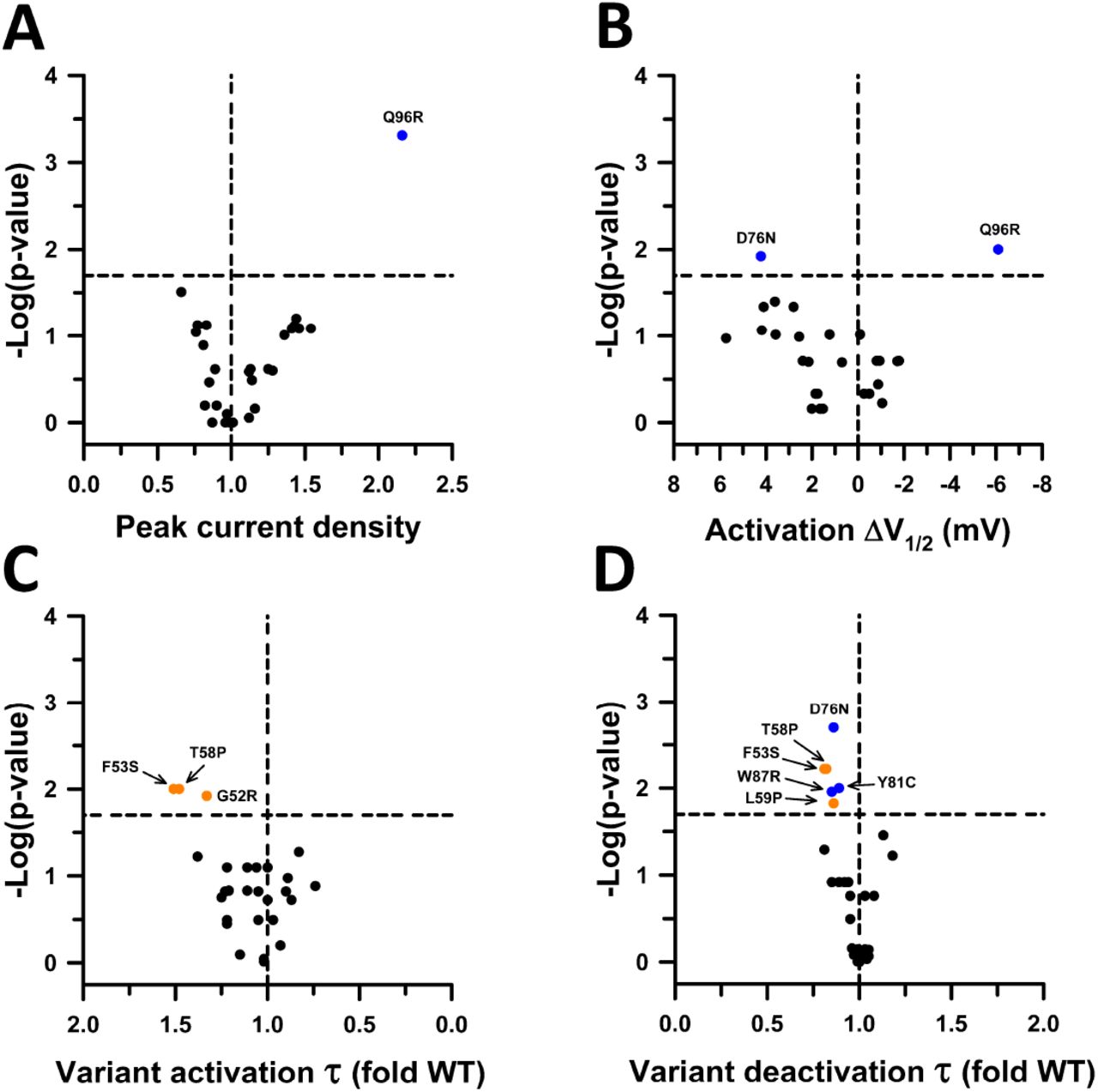
    Functional properties of KCNE1 variants in the heterozygous state. ( A ) Volcano plots of mean JNJ-303 sensitive peak whole-cell current density measured at +60 mV from CHO-E1 cells co-expressing WT KCNQ1 with each KCNE1 variant. Data are displayed as fold divergence from WT channels recorded in parallel. Only variants with peak current density significantly different from WT ( P < 0.02, horizontal dashed line) are labeled. Values to the right or left of the vertical dashed line (normalized WT value) represent current density larger or smaller than WT, respectively. ( B ) Volcano plots of mean difference (ΔV½ in mV) between the averaged V½ for variant and WT channels recorded in parallel. Only variants with peak current density significantly different from WT (P<0.02, horizontal dashed line) are labeled. Values to the right or left of the vertical dashed line indicate hyperpolarized or depolarized activation V½, respectively. ( C ) Volcano plots of mean activation time constants (τ) determined for each heterozygous KCNE1 variant plotted as the ratio to the averaged activation time constant for WT channels recorded in parallel. Values to the right or left of the vertical dashed line (no difference from WT) indicate faster or slower activation, respectively. ( D ) Volcano plots of mean deactivation time constants (τ) determined for each heterozygous KCNE1 variant plotted as the ratio to the averaged deactivation time constant for WT channels recorded in parallel. Values to the right or left of the vertical dashed line indicate slower or faster deactivation, respectively. Symbols colors are defined in previous figures. The number of recorded cells for each variant and individual P -values are presented in Supplemental Dataset 2 . Scatter plots of individual data are presented in Supplemental Figure S8 .

    Journal: bioRxiv

    Article Title: Functional profiling of KCNE1 variants informs population carrier frequency of Jervell and Lange-Nielsen syndrome type 2

    doi: 10.1101/2025.03.28.646046

    Figure Lengend Snippet: Functional properties of KCNE1 variants in the heterozygous state. ( A ) Volcano plots of mean JNJ-303 sensitive peak whole-cell current density measured at +60 mV from CHO-E1 cells co-expressing WT KCNQ1 with each KCNE1 variant. Data are displayed as fold divergence from WT channels recorded in parallel. Only variants with peak current density significantly different from WT ( P < 0.02, horizontal dashed line) are labeled. Values to the right or left of the vertical dashed line (normalized WT value) represent current density larger or smaller than WT, respectively. ( B ) Volcano plots of mean difference (ΔV½ in mV) between the averaged V½ for variant and WT channels recorded in parallel. Only variants with peak current density significantly different from WT (P<0.02, horizontal dashed line) are labeled. Values to the right or left of the vertical dashed line indicate hyperpolarized or depolarized activation V½, respectively. ( C ) Volcano plots of mean activation time constants (τ) determined for each heterozygous KCNE1 variant plotted as the ratio to the averaged activation time constant for WT channels recorded in parallel. Values to the right or left of the vertical dashed line (no difference from WT) indicate faster or slower activation, respectively. ( D ) Volcano plots of mean deactivation time constants (τ) determined for each heterozygous KCNE1 variant plotted as the ratio to the averaged deactivation time constant for WT channels recorded in parallel. Values to the right or left of the vertical dashed line indicate slower or faster deactivation, respectively. Symbols colors are defined in previous figures. The number of recorded cells for each variant and individual P -values are presented in Supplemental Dataset 2 . Scatter plots of individual data are presented in Supplemental Figure S8 .

    Article Snippet: Full length cDNA encoding WT KCNQ1 (GenBank accession number AF000571 ) was engineered in the mammalian expression vector pIRES-CyOFP1 (pIRES-CyOFP1-KCNQ1, AddGene #173162).

    Techniques: Functional Assay, Expressing, Variant Assay, Labeling, Activation Assay

    Functional properties of KCNE1 variants in the heterozygous state. ( A ) Average JNJ-303-sensitive peak whole-cell current density measured at +60 mV from CHO-E1 cells co-expressing WT KCNQ1 with each KCNE1 variant. Data are displayed as fold divergence from WT channels recorded in parallel. Values to the right or left of the vertical dashed line (normalized WT value) represent current density larger or smaller than WT, respectively. ( B ) Activation voltage-dependence for each heterozygous KCNE1 variant plotted as the difference (ΔV½ in mV) between the averaged V½ for WT channels recorded in parallel. Values to the right or left of the vertical dashed line indicate hyperpolarized or depolarized activation V½, respectively. ( C ) Activation time constants (τ) determined for each heterozygous KCNE1 variant plotted as the ratio to the averaged activation time constant for WT channels recorded in parallel. Values to the right or left of the vertical dashed line (no difference from WT) indicate faster or slower activation, respectively. ( D ) Deactivation time constants (τ) determined for each heterozygous KCNE1 variant plotted as the ratio to the averaged deactivation time constant for WT channels recorded in parallel. Values to the right or left of the vertical dashed line indicate slower or faster deactivation, respectively. Location of variants is indicated by the colored symbols (green = N-terminus; orange = TM domain; blue = C-terminus). The number of recorded cells for each variant and individual P -values are presented in Dataset 2 .

    Journal: bioRxiv

    Article Title: Functional profiling of KCNE1 variants informs population carrier frequency of Jervell and Lange-Nielsen syndrome type 2

    doi: 10.1101/2025.03.28.646046

    Figure Lengend Snippet: Functional properties of KCNE1 variants in the heterozygous state. ( A ) Average JNJ-303-sensitive peak whole-cell current density measured at +60 mV from CHO-E1 cells co-expressing WT KCNQ1 with each KCNE1 variant. Data are displayed as fold divergence from WT channels recorded in parallel. Values to the right or left of the vertical dashed line (normalized WT value) represent current density larger or smaller than WT, respectively. ( B ) Activation voltage-dependence for each heterozygous KCNE1 variant plotted as the difference (ΔV½ in mV) between the averaged V½ for WT channels recorded in parallel. Values to the right or left of the vertical dashed line indicate hyperpolarized or depolarized activation V½, respectively. ( C ) Activation time constants (τ) determined for each heterozygous KCNE1 variant plotted as the ratio to the averaged activation time constant for WT channels recorded in parallel. Values to the right or left of the vertical dashed line (no difference from WT) indicate faster or slower activation, respectively. ( D ) Deactivation time constants (τ) determined for each heterozygous KCNE1 variant plotted as the ratio to the averaged deactivation time constant for WT channels recorded in parallel. Values to the right or left of the vertical dashed line indicate slower or faster deactivation, respectively. Location of variants is indicated by the colored symbols (green = N-terminus; orange = TM domain; blue = C-terminus). The number of recorded cells for each variant and individual P -values are presented in Dataset 2 .

    Article Snippet: Full length cDNA encoding WT KCNQ1 (GenBank accession number AF000571 ) was engineered in the mammalian expression vector pIRES-CyOFP1 (pIRES-CyOFP1-KCNQ1, AddGene #173162).

    Techniques: Functional Assay, Expressing, Variant Assay, Activation Assay

    Correlation of peak current density with functional and trafficking scores from a KCNE1 deep mutation scan. ( A ) Plot of peak current density measured in cells co-expressing WT KCNQ1 with KCNE1 variants (homozygous state) compared with the Functional Score reported for each variant determined by a cell fitness assay. ( B ) Plot of peak current density measured in cells co-expressing WT KCNQ1 with KCNE1 variants (homozygous state) compared with the reported Trafficking Score for each variant. In both plots, solid blue lines represent a linear regression fit to the data with 95% CI shown as light blue shadow.

    Journal: bioRxiv

    Article Title: Functional profiling of KCNE1 variants informs population carrier frequency of Jervell and Lange-Nielsen syndrome type 2

    doi: 10.1101/2025.03.28.646046

    Figure Lengend Snippet: Correlation of peak current density with functional and trafficking scores from a KCNE1 deep mutation scan. ( A ) Plot of peak current density measured in cells co-expressing WT KCNQ1 with KCNE1 variants (homozygous state) compared with the Functional Score reported for each variant determined by a cell fitness assay. ( B ) Plot of peak current density measured in cells co-expressing WT KCNQ1 with KCNE1 variants (homozygous state) compared with the reported Trafficking Score for each variant. In both plots, solid blue lines represent a linear regression fit to the data with 95% CI shown as light blue shadow.

    Article Snippet: Full length cDNA encoding WT KCNQ1 (GenBank accession number AF000571 ) was engineered in the mammalian expression vector pIRES-CyOFP1 (pIRES-CyOFP1-KCNQ1, AddGene #173162).

    Techniques: Functional Assay, Mutagenesis, Expressing, Variant Assay

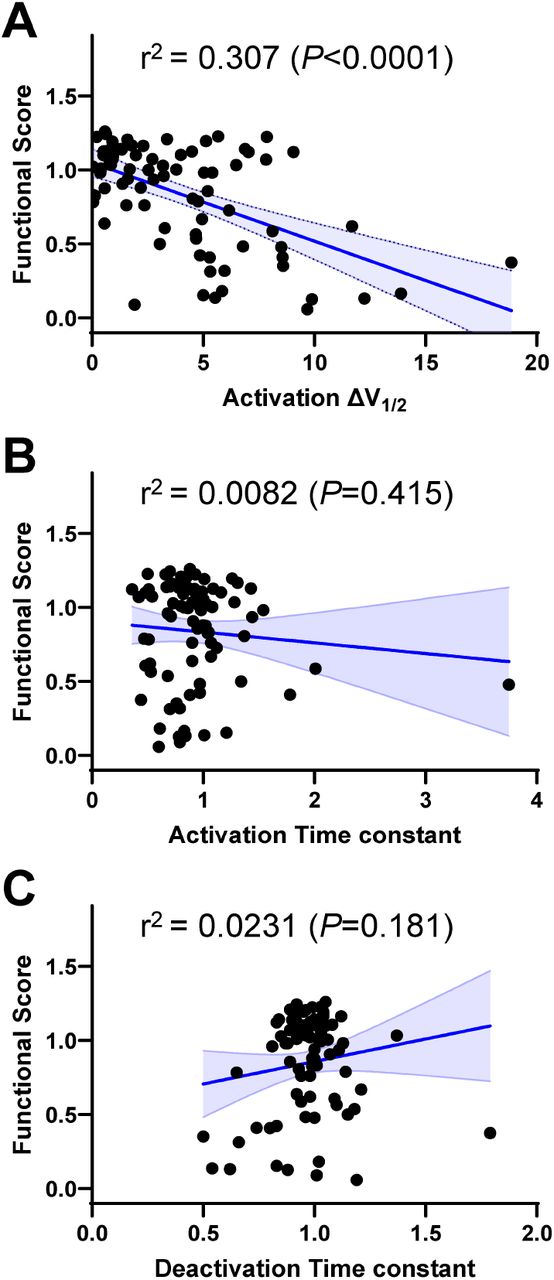
    Correlation of biophysical properties with functional scores from a KCNE1 deep mutation scan. ( A ) Plot of differences in activation V½ (ΔV½ in mV) measured in cells co-expressing WT KCNQ1 with KCNE1 variants (homozygous state) compared with the Functional Score reported for each variant determined by a cell fitness assay. ( B ) Plot of differences in activation time constants measured in cells co-expressing WT KCNQ1 with KCNE1 variants (homozygous state) compared with the reported Functional Score. ( C ) Plot of differences in deactivation time constants measured in cells co-expressing WT KCNQ1 with KCNE1 variants (homozygous state) compared with the reported Functional Score.

    Journal: bioRxiv

    Article Title: Functional profiling of KCNE1 variants informs population carrier frequency of Jervell and Lange-Nielsen syndrome type 2

    doi: 10.1101/2025.03.28.646046

    Figure Lengend Snippet: Correlation of biophysical properties with functional scores from a KCNE1 deep mutation scan. ( A ) Plot of differences in activation V½ (ΔV½ in mV) measured in cells co-expressing WT KCNQ1 with KCNE1 variants (homozygous state) compared with the Functional Score reported for each variant determined by a cell fitness assay. ( B ) Plot of differences in activation time constants measured in cells co-expressing WT KCNQ1 with KCNE1 variants (homozygous state) compared with the reported Functional Score. ( C ) Plot of differences in deactivation time constants measured in cells co-expressing WT KCNQ1 with KCNE1 variants (homozygous state) compared with the reported Functional Score.

    Article Snippet: Full length cDNA encoding WT KCNQ1 (GenBank accession number AF000571 ) was engineered in the mammalian expression vector pIRES-CyOFP1 (pIRES-CyOFP1-KCNQ1, AddGene #173162).

    Techniques: Functional Assay, Mutagenesis, Activation Assay, Expressing, Variant Assay